How the Caribbean sea anemone can tackle autoimmune and neuroinflammatory diseases

PhD candidate Karol Sanches recently published a paper in Proteins: Structure, Function, and Bioinformatics about the heterologous expression of the intrinsic membrane protein of the Caribbean sea anome.

The venoms of sea anemones are rich mixtures of biologically active compounds, some of which have the potential to be developed into novel therapeutics or bioinsecticides. ShK is a 35-residue peptide first isolated from the Caribbean sea anemone Stichodactyla helianthus as a potent blocker of voltage-gated potassium channels. The upregulation of one of these channels, KV1.3, occurs in many autoimmune and neuroinflammatory diseases, and inhibitors are therefore valuable molecular tools and potential therapeutic leads. The heterologous expression of this intrinsic membrane protein is one of the projects being pursued within the CFBD.

     Since its discovery in a sea anemone, the ShKT domain has been found in numerous other species, including plants, algae, protozoa, other cnidarians (such as hydra and jellyfish), sea urchins, molluscs, sea squirts, fish, nematodes, parasitic worms, snakes, amphibians, birds, and mammals. However, only a small fraction of these ShKT domains has been characterized functionally. Although some peptides display the same ShK-like fold and contain the dyad Lys-Tyr important for KV1.3 blockade, their function may not be related to potassium channel inhibition. As ShKT domains are highly abundant in nature and their functions are important to define, we investigated whether a combination of structure determination and/or prediction with molecular dynamics (MD) simulations could be useful for predicting activity against voltage-gated potassium channels. We show that weak or absent activity against KV1.x channels correlated with either a buried or only partially exposed dyad during MD simulations. We anticipate that structure determination in combination with MD simulations may allow the function of new sequences in the ShKT family to be predicted, at least for potassium channel blockers.

How the venom of sea anemones can tackle Alzheimer’s and Parkinson’s

PhD student Karol Sanches (Monash node) recently published a paper titled “Interaction of the Inhibitory Peptides ShK and HmK with the Voltage-Gated Potassium Channel KV1.3: Role of Conformational Dynamics” in J. Chem. Inf. Model.

In her paper, she describes the effects of KV1.3 on diseases like Alzheimer’s and Parkinson’s. KV1.3 is a voltage-gated potassium channel found in the membrane of the cells. The upregulation of KV1.3 in T lymphocytes is related to many autoimmune diseases and, in microglia, in the brains of patients with Alzheimer’s and Parkinson’s diseases and ischemic stroke. The blockage of KV1.3 is an attractive mechanism for treating autoimmune and neuroinflammatory diseases. Indeed, several peptides found in the venom of sea anemones have proven to be potent blockers of KV1.3, including the ShK from Stichodactyla helianthus, and HmK from Heteractis magnifica, both inhibitors of the KV1.3 channel.

Mutagenesis analysis have shown that both peptides block KV1.3 through the Lys-Tyr dyad. Although ShK and HmK share 60% sequence identity by BLAST, ShK is nearly 300-fold more potent against KV1.3 than HmK. We used a combination of docking and molecular dynamics (MD) simulations to investigate the conformational dynamics in ShK and HmK and the implications of this flexibility for channel recognition. Besides sharing high sequence and structure identity, the dynamics of ShK and HmK differ. While HmK is highly rigid, ShK is dynamic, sampling three major configurations. Both peptides bind to KV1.3 with Lys22 occupying the channel’s pore; intriguingly, the more flexible peptide, ShK, binds with significantly higher affinity than HmK.

Find the full paper here.

Paper alert! Rapid Elaboration of Fragments into Leads (REFiL)

The challenge in fragment-based drug discovery (FBDD) is not finding hits, we typically find plenty, it’s what to do with them. In their recent publication, Centre members demonstrate a systematic approach for the Rapid Elaboration of Fragments into Leads (REFiL), where they take weak binding fragment hits and quickly develop them into higher affinity ligands that can be used as chemical probes or as starting points for a drug discovery program.

The paper was published in the Journal of Medicinal Chemistry by the following researchers and Centre members: Luke Adams, Lorna Wilkinson-White, Menachem Gunzburg, Stephen Headey, Biswaranjan Mohanty, Centre Director Martin Scanlon, Deputy Director Ben Capuano, Theme Leader Joel Mackay and Brad Doak.

Abstract

The development of low-affinity fragment hits into higher-affinity leads is a major hurdle in fragment-based drug design. Here, we demonstrate the Rapid Elaboration of Fragments into Leads (REFiL) by applying an integrated workflow that provides a systematic approach to generate higher-affinity binders without the need for structural information. The workflow involves the selection of commercial analogues of fragment hits to generate preliminary structure–activity relationships. This is followed by parallel microscale chemistry using chemoinformatically designed reagent libraries to rapidly explore chemical diversity. After a fragment screen against bromodomain-3 extra-terminal (BRD3-ET) domain, we applied the REFiL workflow, which allowed us to develop a series of ligands that bind to BRD3-ET. With REFiL, we were able to rapidly improve binding affinity > 30-fold. REFiL can be applied readily to a broad range of proteins without the need for a structure, allowing the efficient evolution of low-affinity fragments into higher-affinity leads and chemical probes.

New paper out! CFBD alumna publishes work on fragment screening libraries

CFBD alumna Dr Rebecca Whitehouse published her paper “Fragment screening libraries for the identification of protein hot spots and their minimal binding pharmacophores” in RSC Medicinal Chemistry this week.

Abstract

Fragment-based drug design relies heavily on structural information for the elaboration and optimisation of hits. The ability to identify neighbouring binding hot spots, energetically favourable interactions and conserved binding motifs in protein structures through X-ray crystallography can inform the evolution of fragments into lead-like compounds through structure-based design. The composition of fragment libraries can be designed and curated to fit this purpose and herein, we describe and compare screening libraries containing compounds comprising between 2 and 18 heavy atoms. We evaluate the properties of the compounds in these libraries and assess their ability to probe protein surfaces for binding hot spots.

A truly collaborative work – new paper on DsbA

Not one but five CFBD members from our three nodes published a paper on DsbA titled “Identification and characterization of two drug-like fragments that bind to the same cryptic binding pocket of Burkholderia pseudomallei DsbA” in Acta Crystallographica Section D.

Abstract

Disulfide-bond-forming proteins (Dsbs) play a crucial role in the pathogenicity of many Gram-negative bacteria. Disulfide-bond-forming protein A (DsbA) catalyzes the formation of the disulfide bonds necessary for the activity and stability of multiple substrate proteins, including many virulence factors. Hence, DsbA is an attractive target for the development of new drugs to combat bacterial infections. Here, two fragments, bromophenoxy propanamide (1) and 4-methoxy-N-phenylbenzenesulfonamide (2), were identified that bind to DsbA from the pathogenic bacterium Burkholderia pseudomallei, the causative agent of melioidosis. The crystal structures of oxidized B. pseudomallei DsbA (termed BpsDsbA) co-crystallized with 1 or 2 show that both fragments bind to a hydrophobic pocket that is formed by a change in the side-chain orientation of Tyr110. This conformational change opens a `cryptic’ pocket that is not evident in the apoprotein structure. This binding location was supported by 2D-NMR studies, which identified a chemical shift perturbation of the Tyr110 backbone amide resonance of more than 0.05 p.p.m. upon the addition of 2 mM fragment 1 and of more than 0.04 p.p.m. upon the addition of 1 mM fragment 2. Although binding was detected by both X-ray crystallography and NMR, the binding affinity (Kd) for both fragments was low (above 2 mM), suggesting weak interactions with BpsDsbA. This conclusion is also supported by the crystal structure models, which ascribe partial occupancy to the ligands in the cryptic binding pocket. Small fragments such as 1 and 2 are not expected to have a high energetic binding affinity due to their relatively small surface area and the few functional groups that are available for intermolecular interactions. However, their simplicity makes them ideal for functionalization and optimization. The identification of the binding sites of 1 and 2 to BpsDsbA could provide a starting point for the development of more potent novel antimicrobial compounds that target DsbA and bacterial virulence.

Read the full article here.

First Author paper for PhD student Sarah Müller

Congratulations to PhD student Sarah Müller from Griffith University who published a paper as first author. 

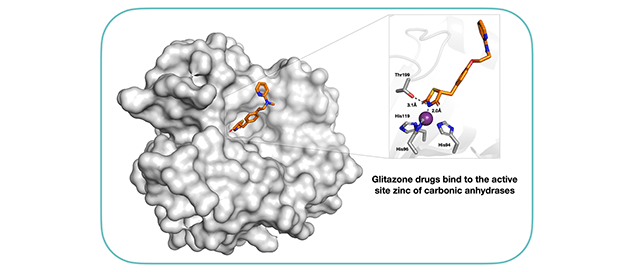
The Glitazone Class of Drugs as Carbonic Anhydrase Inhibitors—A Spin-Off Discovery from Fragment Screening

Most of the drugs we know target the activity of specific proteins that play an important role in the disease being treated. One of the big challenges in the discovery of new drugs is finding molecules that bind specifically to one target and not bind to other proteins too. This is necessary to avoid causing treatment side effects. Hence, drug discovery researchers are always on the lookout for ways to find better lead molecules.
We identified an old drug class called glitazones that target a new protein known as carbonic anhydrase II, an enzyme that helps to maintain pH levels in cells. Carbonic anhydrase comes in many different forms and has been a successful target for drug development for various diseases like glaucoma, heart failure and epilepsy.
The glitazone drugs, such as rosiglitazone, are used to treat Type II diabetes. However, because of the severe side effects caused by the use of glitazones they were taken off the market. Our findings suggest that the unintended targeting of carbonic anhydrase may be one reason for the side effects of these drugs. This shows how important it is to carry out research to fully understand the effect of drugs and can help future researchers in drug discovery.

The paper was published in Molecules in May 2021.

New paper out by PhD student Karoline Sanches

Congratulations to PhD student Karoline Sanches from Monash University who published a paper as first author. The paper was published in Toxicon in October 2021.

Conformational dynamics in peptide toxins: Implications for receptor interactions and molecular design

Karoline Sanchesa,b,1, Dorothy C.C. Waia,1, Raymond S. Nortona,b
aMedicinal Chemistry, Monash Institute of Pharmaceutical Sciences, Monash University, Parkville, Victoria, 3052, Australia
bARC Centre for Fragment-Based Design, Monash University, Parkville, Victoria, 3052, Australia
1These authors contributed equally

Peptide toxins are often potent and selective blockers of ion channels and are therefore of significant interest to the pharmaceutical and biotech industries. For example, an analogue of the sea anemone peptide ShK, which targets the voltage-gated potassium channel Kv1.3, is currently in clinical trials for the treatment of autoimmune disorders. Studying the structure-function relationship and the dynamics of these peptides is pivotal to understanding their binding to receptors, as well as to designing new drugs. In this article, we highlight the important contribution of NMR to characterising peptide toxin dynamics. It is shown that even disulphide-rich peptides display dynamics in various timescales, the characterisation of which through NMR is crucial for understanding their receptor interactions.