…is neither an end nor a beginning but a going on with all the wisdom that experience can instil in us. – Hal Berland
This year has been filled with the challenges of sorting out the remaining placements and achievements such as thesis submissions at the Monash and Sydney nodes.
CFBD is slowly coming to an end but we can still look back on a number of achievements and experiences:
Our Centre Director was appointed as MedChem Theme Leader in March
We held a joint ITRP Career Day at Swinburne Uni in April
We took FBBD_DU and our Final Research Workshop to Brisbane in June
Brooke from the Monash node presented at BioMolecular Horizons in September
We co-hosted the international FBLD conference in Boston
Griffith CI Sally-Ann Poulsen received the 2024 Margaret Sheil Leadership Award in October
Let us carry forward this success as we enter the final year of CFBD. Wishing you all a restful break and a prosperous new year ahead.
This year marks the official planned end date of the ARC Industrial Transformation Training Centre for Fragment-Based Design. We are looking back at five successful years of partnership with our researchers, collaborators and industry partners.
It has been quite an unusual 5 years with the pandemic interrupting our operations. Nevertheless, we managed to work on exciting projects.
It’s time to celebrate our achievements at the Final CFBD Forum. The Final Forum will be held together with the 5th Fragment-Based Drug Discovery Down Under Conference in sunny Brisbane. We are inviting all CFBD members to join us on 24 June at the UQ City Campus.
We are looking forward to welcoming everyone to Brisbane soon!
Congratulations to 3 CFBD CIs for being awarded NHMRC Grants totalling almost $3 million.
Prof Ray Norton has been awarded an NHMRC Development Grant worth $753,140
His project is titled “Development of a Kv1.3 Potassium Channel Inhibitor as a New Class of Treatment for Diabetic Kidney Disease”. Diabetic kidney disease (DKD) is a major public health problem, which is associated with kidney failure, cardiovascular disease and premature death. Current therapies often fail to stop disease progression. There is an urgent need for innovative strategies to prevent, arrest and reverse the development of DKD. Ray’s project will advance the development of a novel therapeutic for DKD that acts by a different mechanism from current drugs and has shown considerable promise in animal models of DKD.
Prof Michael Kassiou was successful with NHMRC Ideas Grant
His project titled “Developing Senolytics for treatment of Amyotrophic Lateral Sclerosis” received a total of $1,037,875. When the body senses damaged cells, it can usually eliminate them, but dangerous senescent cells upregulate proteins such as Bcl-2 and Bcl-xl which make them resistant to the body’s elimination processes. These senescent cells accumulate in amyotrophic lateral sclerosis (ALS). We are developing novel Bcl-2 and Bcl-xl inhibitors which selectively eliminate these senescent cells without eliminating healthy cells to examine the role of senescence in ALS and to develop new ALS treatments.
Prof Joel Mackay also received NHMRC Ideas Grant
For his project “RaPID assessment of the chromatin remodeller CHD4 as a therapeutic target for hemoglobinopathies using a new target validation strategy”, Joel has been awarded $1,133,816. Recently, the enzyme CHD4 has emerged as a possible therapeutic target for hemoglobinopathies. However, no molecules exist that specifically inhibit its activity. The goal of this project is to develop specific chemical probes to assess the potential of CHD4 inhibition for the treatment of hematological disorders. The work will also provide proof-of-principle for a new strategy that we propose for faster validation of therapeutic targets.
CFBD CI Prof Michael Kassiou, founder of Kinoxis, has secured a lucrative partnership with Boehringer Ingelheim to investigate drugs that treat aggression and social withdrawal in people with psychiatric disorders.
Michael developed small molecules that interact with oxytocin receptors which could be used to target oxytocin receptors with the aim of creating medicine to treat schizophrenia, depression and other neuropsychiatric illness. Read the full article in the Sydney Morning Herald from 4 May.
The challenge in fragment-based drug discovery (FBDD) is not finding hits, we typically find plenty, it’s what to do with them. In their recent publication, Centre members demonstrate a systematic approach for the Rapid Elaboration of Fragments into Leads (REFiL), where they take weak binding fragment hits and quickly develop them into higher affinity ligands that can be used as chemical probes or as starting points for a drug discovery program.
The development of low-affinity fragment hits into higher-affinity leads is a major hurdle in fragment-based drug design. Here, we demonstrate the Rapid Elaboration of Fragments into Leads (REFiL) by applying an integrated workflow that provides a systematic approach to generate higher-affinity binders without the need for structural information. The workflow involves the selection of commercial analogues of fragment hits to generate preliminary structure–activity relationships. This is followed by parallel microscale chemistry using chemoinformatically designed reagent libraries to rapidly explore chemical diversity. After a fragment screen against bromodomain-3 extra-terminal (BRD3-ET) domain, we applied the REFiL workflow, which allowed us to develop a series of ligands that bind to BRD3-ET. With REFiL, we were able to rapidly improve binding affinity > 30-fold. REFiL can be applied readily to a broad range of proteins without the need for a structure, allowing the efficient evolution of low-affinity fragments into higher-affinity leads and chemical probes.
CFBD researchers are again invited to apply for a CFBD Travel Grant to the value of up to $3,500. This grant may be used for travel to a national or international conference, a visit to a partner organisation for research collaboration or a visit to a research laboratory to learn a new technique. The CFBD TravelGrant is an annual award.
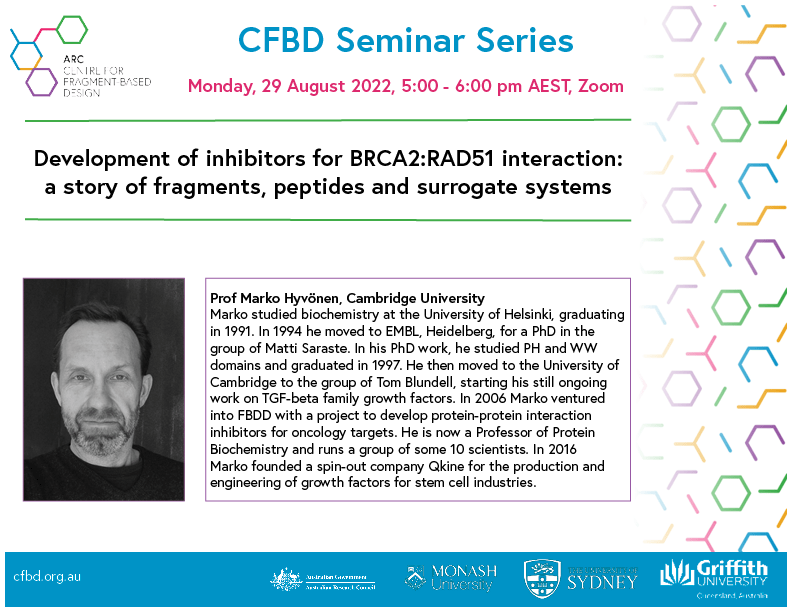
Another round of the CFBD Seminar Series is coming on 29 August 2022: Prof Marko Hyvönen will talk about the development of inhibitors for BRCA2:RAD51 interaction.
The Royal Australian Chemical Institute (RACI) is the national professional body for chemists in industry, academia and government and is the primary voice of chemistry in Australia. Every five years the RACI holds a national Congress, with the RACI 2022 National Congress held from 3 to 8 July in Brisbane. This was a significant meeting (last held in 2017) with 1,148 people registered to attend, 615 speakers, 21 exhibitors, 12 sponsors and 325 poster presentations.
The CFBD members were heavily involved in the fabric of this significant meeting. CI Prof Sally-Ann Poulsen (Griffith Uni) was on the RACI2022 Congress Organising Committee and was Symposium Chair of the 4-day Medicinal Chemistry & Chemical Biology Symposium (the largest of all the Symposiums within the Congress). CI Prof Michael Kassiou (Uni Sydney) and Dr Louise Sternicki (Griffith Uni) were invited speakers, with Dr Luke Adams (Monash) and PhD Candidate Ashley Taylor (Monash) giving contributed talks and PhD Candidate Jamie Currie (Monash)- together showcasing the breadth of ARC CFBD research, while ARC CFBD Chief Investigators, ECRs and PhD candidates from the three universities and several of our industry partners were well represented. We were fortunate to have a catch-up dinner during the Congress – meeting face-2-face for the first time and a lot of laughs to be had. ‘The First Scientists’ artwork for the Congress is by Artist Steven Bekue.
Not one but five CFBD members from our three nodes published a paper on DsbA titled “Identification and characterization of two drug-like fragments that bind to the same cryptic binding pocket of Burkholderia pseudomallei DsbA” in Acta Crystallographica Section D.
Abstract
Disulfide-bond-forming proteins (Dsbs) play a crucial role in the pathogenicity of many Gram-negative bacteria. Disulfide-bond-forming protein A (DsbA) catalyzes the formation of the disulfide bonds necessary for the activity and stability of multiple substrate proteins, including many virulence factors. Hence, DsbA is an attractive target for the development of new drugs to combat bacterial infections. Here, two fragments, bromophenoxy propanamide (1) and 4-methoxy-N-phenylbenzenesulfonamide (2), were identified that bind to DsbA from the pathogenic bacterium Burkholderia pseudomallei, the causative agent of melioidosis. The crystal structures of oxidized B. pseudomallei DsbA (termed BpsDsbA) co-crystallized with 1 or 2 show that both fragments bind to a hydrophobic pocket that is formed by a change in the side-chain orientation of Tyr110. This conformational change opens a `cryptic’ pocket that is not evident in the apoprotein structure. This binding location was supported by 2D-NMR studies, which identified a chemical shift perturbation of the Tyr110 backbone amide resonance of more than 0.05 p.p.m. upon the addition of 2 mM fragment 1 and of more than 0.04 p.p.m. upon the addition of 1 mM fragment 2. Although binding was detected by both X-ray crystallography and NMR, the binding affinity (Kd) for both fragments was low (above 2 mM), suggesting weak interactions with BpsDsbA. This conclusion is also supported by the crystal structure models, which ascribe partial occupancy to the ligands in the cryptic binding pocket. Small fragments such as 1 and 2 are not expected to have a high energetic binding affinity due to their relatively small surface area and the few functional groups that are available for intermolecular interactions. However, their simplicity makes them ideal for functionalization and optimization. The identification of the binding sites of 1 and 2 to BpsDsbA could provide a starting point for the development of more potent novel antimicrobial compounds that target DsbA and bacterial virulence.
Congratulations to CFBD CI Professor Joel Mackay from Sydney University who received an NHMRC Ideas Grant worth $829, 494.
New approaches to cancer treatment through mRNA display
This project will pioneer the development of a new class of molecules – cyclic peptides – that will block the activity of proteins that regulate gene expression and have been shown to be promising targets for a range of diseases, predominantly cancer. These molecules have the potential to be much more selective and potent than existing molecules and to also open up new directions for cancer therapy by allowing previously intractable molecular targets to be addressed.





 ARC Centre for Fragment-Based Design