As the first interview for the series, we have Charlotte Williams, a Principal Research Scientist and Group Leader for Chemical Biology, Diagnostics and Devices within the Biomedical Manufacturing Program at CSIRO (Commonwealth Scientific and Industrial Research Organisation).
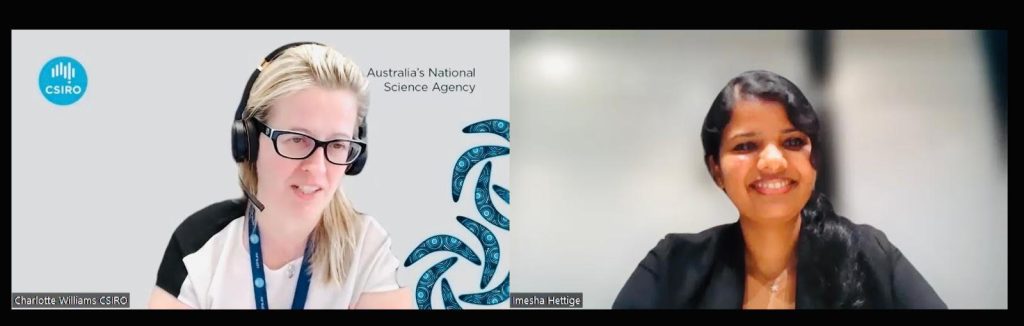
Q) Can you let us know a bit about yourself? What did you study for your postgraduate degree?
– I enjoyed science at school, particularly chemistry and so I enrolled at the University of Western Australia for my undergrad and did a double major in chemistry and biochemistry.
In my 3rd year, I was contemplating the honours program, and couldn’t decide between chemistry and biochemistry. After talking to a few lab supervisors and PhD students, I found a connection with chemistry and went on to enjoy my Honours year and research work in chemistry. I did traditional organic chemistry synthesis, expanding into transition metal complex synthesis for use as catalysts for use in Suzuki and Heck coupling reactions. It felt like a natural progression to do a PhD remaining at the University of Western Australia. I think it’s important for students to consider carefully the choice to enter into a PhD, since it is a big commitment lasting at least 3 years.
Q) After your postgraduate degree, how did you get to where you are now?
– Close to the end of my PhD, I began looking into what my next step could be. I started applying for jobs at various Australian biotech companies and post-docs in Australia and those open in the UK. I was grateful to accept a postdoctoral fellowship at the University of Oxford. This work involved organic chemistry as well as polymer chemistry, making monomers and then preparing conjugated polymers known as polyrotaxanes.
Towards the end of my postdoc, I heard through colleagues at the university, that Johnson Matthey Technology Centre (JMTC, UK) were looking for a chemist. After the application and interview process, I was offered a role there working on transition metal catalysts, and making transition metal nanoparticles. John Matthey is a large international organisation, a global leader in sustainable technologies, well known for their work in transition metal chemistry including the preparation of platinum anti-cancer drugs related to cisplatin.
After a year or so, I started looking for jobs to move back to Australia and applied for a post-doctoral fellowship at the CRC for Polymers in Melbourne. I had also seen an advert for a role at an Australian Biotech company, Starpharma, also based in Melbourne. I was thankful to be offered both roles and with a keen interest in Biotech, I was given great advice to make decisions based on what I wanted to do for my career, not what I thought I should do. I started working at Starpharma, where I worked and gained experience making dendrimers for drug delivery, which are highly ordered, branched polymeric molecules.
After 5 ½ years in Biotech, I began to think about my next steps. My network connections led me to an interview at CSIRO, which is where I have worked since 2009 as a research scientist. In the Biomedical Manufacturing Program at CSIRO, we assist Australian Biotech and Medtech companies in their growth strategies. Delivering to organic chemistry, polymer chemistry and bioconjugation chemistry focussed projects I developed project leadership skills, client engagement and became a Team Leader. My current role as a Group Leader involves operational and capability management, mentoring and people leadership while maintaining active involvement in business development, projects, and science leadership.
Q) Were there any differences you noticed in your experiences working with these different companies?
-Yes, the experiences were quite different, working for a Biotech company such as Starpharma versus working for a large company like Johnson Matthey. In a Biotech, the focus is on very narrow goals and strategic outcomes that are important for the company, and you often learn about each different area that is required to move a lead towards each stage for translation.
Working in a large company like Johnson Matthey, you can be exposed to a broad range of science areas, and you often get to contribute across varied projects, which helps you to expand your knowledge into different skill sets. At Johnson Matthey, I learnt to think about, and plan for, the translation of processes from R&D to pilot scale. At CSIRO, I often work across a range of multidisciplinary projects, constantly developing new processes and products, delivering different science outputs, and always learning from the expertise of my colleagues.
Q) How did you decide that you wanted to step into industry and away from academia?
– As I was finishing my postdoc, I considered the prospects of working in academia versus industry. I enjoyed the research aspects of academia and the scientific freedom that academia offers, as well as the opportunity to support the next generation of students, but the industry opportunity was available and I was keen to find out what working in industry was like.
Working at Johnson Matthey right after my postdoc was a great experience; I enjoyed the work and made friends and connections, many of whom I’m still in contact with. This first role in industry taught me a lot and presented opportunities. Working on process optimisation, I was able to see the R&D chemistry that I developed, and transferred to the scale-up facilities across the country, where reaction vessels stood from floor to ceiling, which was quite fascinating. Looking back, I never thought of going back to academia after working in the industry.
Q) Did you feel any changes when shifting from academia to industry? How was the translation?
– Yes, there are changes between academia and industry.
With that first initial move to the industry, I realized I needed to think beyond my particular project and more broadly how that project fits into the bigger picture or strategy of the company. Often working in industry, you have timelines to deliver to, for example, delivery of a project for an external client on budget and on time. When I see ECRs move from academia to industry, sometimes the transition to timeline-based work and adherence to protocols and industry systems is a new process that we support them with.
Adhering to certain protocols for example, in industry is often company policy, whereas at a university it is possible that certain protocols vary between research groups. Working in industry, you have to focus on the whole company strategy and alignment, where the work we do supports that bigger picture thinking.
Q) What are the skills you felt you needed or learned as you joined the industry?
– In general, at the entry level, the industry is looking for core expertise at the bench. Everything you learn builds on the skills and expertise you will need for the next steps, and each upskilling leads you down your career pathway.
Often those on-the-bench skills, are learnt at each job, and this training is sometimes preferred in industry once you start working there, rather than new employees being expected to have all these skills upon entry. Other things I learned were science communication, critical thinking, problem-solving, taking responsibility for one’s own work, reaching out to colleagues for their expertise and input and recognising when that input was needed.
Q) Any interesting ideas you have in mind to try out in future?
– One thing I’ve realised is that the more you do, the more widely you engage and work on various multidisciplinary projects, and the more ideas come to you. At CSIRO, when we find ourselves with really exciting science opportunities or ideas that we are interested in exploring, that sit outside of our support of the Biotech and MedTech communities, there are different ways of doing that in CSIRO. One of these paths is through our post-doctoral program. We have been exploring novel antibody-drug-conjugates within the Program, as a way to treat a range of disease states.
Q) Can you also tell us about publishing in companies?
– I suspect this largely depends on the policies of each of the different companies. At CSIRO, there are plenty of opportunities to publish, and this also held true at Starpharma Pty Ltd. At CSIRO, we track our metrics to identify our impact on the science community based on publications. A lot of publications do tend to come through those post-doc positions.
At Johnson Matthey, I did not publish. At many companies, often science that is developed is either patented or kept as a trade secret. Many companies choose to patent these technologies and techniques first, prior to publishing, in order to protect the patent.
Q) What advice would you give to someone facing an interview?
– As much as possible, try to relax and be yourself, give and take, equally listening and responding, making sure to use the interview as a chance to see how you might fit with the company as much as they are seeking if you are a good fit for their needs. When a company advertises for a role, there will very often be selection criteria. My advice is, to make sure you answer the selection criteria. Sometimes in interviews, the questions may be technical as the company wants to employ someone who will be able to do the science that they need, but then again the ability to train on the job is also a huge advantage. I always encourage people to be specific including the details of the chemistry that you’ve done. The panel may ask specific questions, which can be intimidating, but think it through, take the time and be aware that if you know your chemistry, you can always answer these questions.
Industry (as anywhere) is looking for someone who can fit with their team, someone who communicates well and someone with whom they can get on. Take a look at what the roles at the company might be and do a bit of homework to get that extra knowledge about the company. It is also natural to be nervous at an interview but you should just try your best!
Q) Any advice for our students at the CFBD?
-One of the key things is to talk to people, and through talking to people you can learn and make new connections which will always be a very valuable experience.
Also, when joining a company, apart from the amazing science, infrastructure and exposure to different types of projects in science, it is also important to have mentors, support and guidance and to enjoy the people you work with.
– Thank you, Charlotte for letting us have a glimpse at your journey so far and sharing your experiences with us!
 ARC Centre for Fragment-Based Design