We are delighted to announce that Dr Tsz Pun from the Scanlon group at Monash University has been conferred the award Doctor Of Philosophy on 30 April 2025. Congratulations, Jason!
Jason’s thesis is titled: Applying and improving off-rate screening by SPR in the development of FABP4-selective chemical probes, makes a distinct and significant contribution to knowledge.
We are very thrilled and can’t wait to hear about his future endeavours.
🎉 Amazing news! 🎉 Former PhD Candidate Karoline Sanches is the recipient of the 2025 Mollie Holman Award from Monash University. The Mollie Holman Award was established in 1998 and is named after the late pioneering physiologist, Emeritus Professor Mollie Holman AO, in honour of her significant contributions to science and education. This medal is one of the highest academic honours at Monash Uni and marks the recipients as researchers of the highest order. Karol received this award in recognition of her outstanding doctoral thesis entitled “Molecular Basis for Inhibition of the Voltage-Gated Potassium Channel Kvl.3 by Peptide Toxins”. We are very proud of Karol’s achievements.
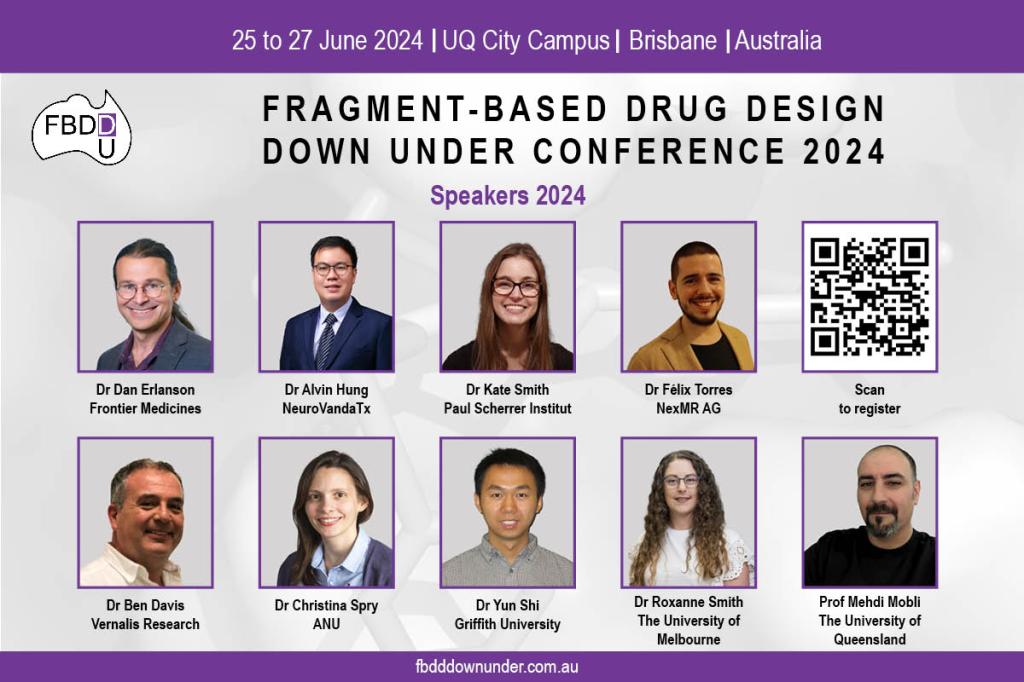
The 5th Fragment-Based Drug Discovery Down Under Meeting (FBDD-DU5) will be held at UQ City Campus in Brisbane, Australia from 25 to 27 June 2024.
This is the first time we are taking the conference away from the Monash Institute of Pharmaceutical Sciences (MIPS) in Melbourne to the warmer weather in Brisbane. The event provides a unique opportunity to support a wide-reaching conference that will focus on fragment-based screening campaigns in drug discovery, delivered by experts actively working in the field from both within academia and industry.
The 2024 conference will bring together an expanding multidisciplinary group of biologists, biochemists, biophysicists, and chemists from academia and industry to hear about the latest techniques and progress in the dynamic and exciting field of fragment-based drug design.
This year marks the official planned end date of the ARC Industrial Transformation Training Centre for Fragment-Based Design. We are looking back at five successful years of partnership with our researchers, collaborators and industry partners.
It has been quite an unusual 5 years with the pandemic interrupting our operations. Nevertheless, we managed to work on exciting projects.
It’s time to celebrate our achievements at the Final CFBD Forum. The Final Forum will be held together with the 5th Fragment-Based Drug Discovery Down Under Conference in sunny Brisbane. We are inviting all CFBD members to join us on 24 June at the UQ City Campus.
We are looking forward to welcoming everyone to Brisbane soon!
We are thrilled to announce that CFBD Director Prof Martin Scanlon has been appointed as the new Theme Leader for Medicinal Chemistry at Monash University in Parkville.
Professor Scanlon will lead a team of scientists focused on synthetic medicinal chemistry, structure-based drug design, fragment screening and academic drug discovery. In addition to CFBD and the Monash Fragment Platform, the Medicinal Chemistry Theme also comprises the Australian Translational Medicinal Chemistry Facility and MedChem Australia (in collaboration with WEHI and The University of Sydney).
More about Prof Scanlon’s appointment and career highlights can be found here.
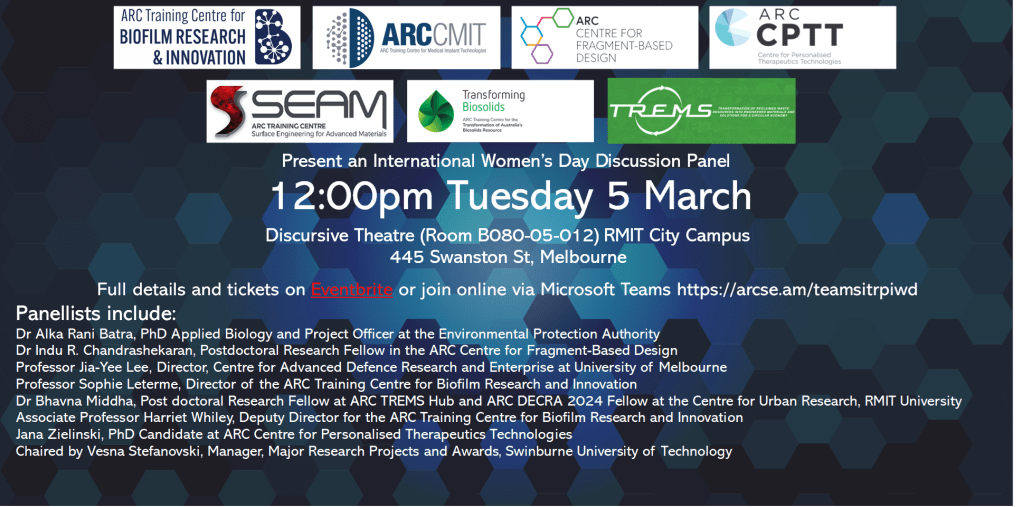
CFBD joins forces with its Australian Research Council Industrial Industrial Transformation Research Initiatives to host the 2024 International Women’s Day Panel Discussion on the theme of Inspire Inclusion in Academic Research. Join us from 12pm on Tuesday 5 March at RMIT University‘s City Campus.
Follow this link for more details and register here.
Congratulations to 3 CFBD CIs for being awarded NHMRC Grants totalling almost $3 million.
Prof Ray Norton has been awarded an NHMRC Development Grant worth $753,140
His project is titled “Development of a Kv1.3 Potassium Channel Inhibitor as a New Class of Treatment for Diabetic Kidney Disease”. Diabetic kidney disease (DKD) is a major public health problem, which is associated with kidney failure, cardiovascular disease and premature death. Current therapies often fail to stop disease progression. There is an urgent need for innovative strategies to prevent, arrest and reverse the development of DKD. Ray’s project will advance the development of a novel therapeutic for DKD that acts by a different mechanism from current drugs and has shown considerable promise in animal models of DKD.
Prof Michael Kassiou was successful with NHMRC Ideas Grant
His project titled “Developing Senolytics for treatment of Amyotrophic Lateral Sclerosis” received a total of $1,037,875. When the body senses damaged cells, it can usually eliminate them, but dangerous senescent cells upregulate proteins such as Bcl-2 and Bcl-xl which make them resistant to the body’s elimination processes. These senescent cells accumulate in amyotrophic lateral sclerosis (ALS). We are developing novel Bcl-2 and Bcl-xl inhibitors which selectively eliminate these senescent cells without eliminating healthy cells to examine the role of senescence in ALS and to develop new ALS treatments.
Prof Joel Mackay also received NHMRC Ideas Grant
For his project “RaPID assessment of the chromatin remodeller CHD4 as a therapeutic target for hemoglobinopathies using a new target validation strategy”, Joel has been awarded $1,133,816. Recently, the enzyme CHD4 has emerged as a possible therapeutic target for hemoglobinopathies. However, no molecules exist that specifically inhibit its activity. The goal of this project is to develop specific chemical probes to assess the potential of CHD4 inhibition for the treatment of hematological disorders. The work will also provide proof-of-principle for a new strategy that we propose for faster validation of therapeutic targets.
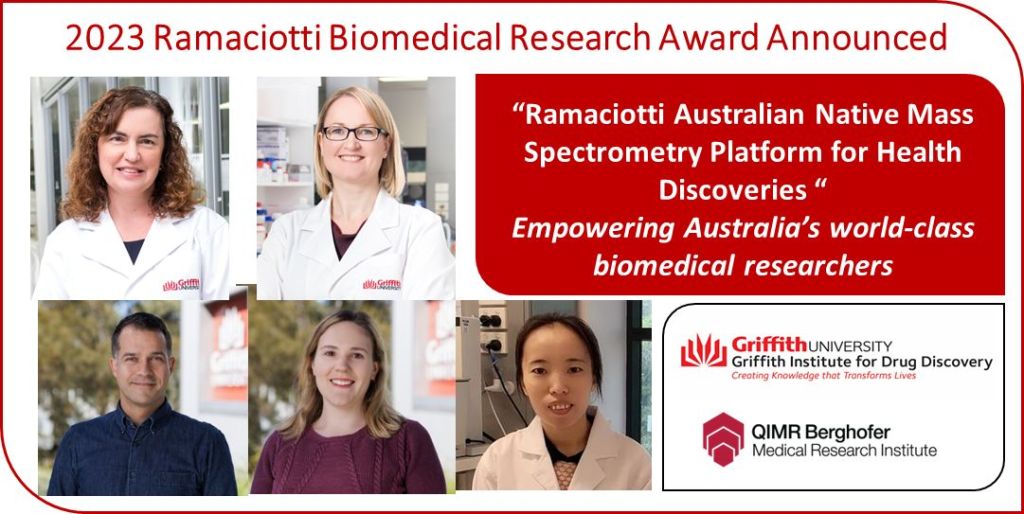
Congratulations to CFBD CI Professor Sally-Ann Poulsen, ECR Dr Louise Sternicki and the team at GRIDD for being the recipient of the prestigious 2023 Ramaciotti Biomedical Research Award.
This $1 million grant from the Ramaciotti Foundations is awarded every two years to a group or individual undertaking biomedical research. The award will fund the purchase and use of a first-in-Australia, cutting-edge new technology – native Charge Detection Mass Spectrometry ‘nCDMS’ that will enable characterisation of complex and large biomolecules and biomolecular interactions that cannot be analysed with existing infrastructure in Australia. The Ramaciotti Australian Native Mass Spectrometry Platform for Health Discoveries will be nationally accessible through the NCRIS Therapeutic Innovation Australia (TIA) platform. CFBD CI Professor Sally-Ann Poulsen was the lead investigator with the GRIDD team together with Professor Kathy Andrews, Frank Sainsbury, CFBD member Dr Louise Sternicki and Miaomiao Liu.
The Parkville Postgraduate Association (PPA) at Monash University held its 18th Annual Graduate Research Symposium yesterday. The main focus of the Symposium is to give graduate research students a platform to showcase their current research whilst improving their public speaking and presentation skills in the form of oral and poster presentations. The annual event provides an excellent opportunity to learn more about the diverse research carried out at the Monash Parkville Campus.
This year, CFBD members were particularly successful at the event: PhD Candidate Jeyan Osman won the People’s Choice Oral Presentation Award worth $150, PhD Candidate Jason Pun received the Oral Presentation Encouragement Award ($100) and PhD Candidate Imesha Hettige Most Outstanding Poster Presentation Award worth $300. Congratulations to all winners at the event!
PhD candidate Karol Sanches recently published a paper in Proteins: Structure, Function, and Bioinformatics about the heterologous expression of the intrinsic membrane protein of the Caribbean sea anome.
The venoms of sea anemones are rich mixtures of biologically active compounds, some of which have the potential to be developed into novel therapeutics or bioinsecticides. ShK is a 35-residue peptide first isolated from the Caribbean sea anemone Stichodactyla helianthus as a potent blocker of voltage-gated potassium channels. The upregulation of one of these channels, KV1.3, occurs in many autoimmune and neuroinflammatory diseases, and inhibitors are therefore valuable molecular tools and potential therapeutic leads. The heterologous expression of this intrinsic membrane protein is one of the projects being pursued within the CFBD.
Since its discovery in a sea anemone, the ShKT domain has been found in numerous other species, including plants, algae, protozoa, other cnidarians (such as hydra and jellyfish), sea urchins, molluscs, sea squirts, fish, nematodes, parasitic worms, snakes, amphibians, birds, and mammals. However, only a small fraction of these ShKT domains has been characterized functionally. Although some peptides display the same ShK-like fold and contain the dyad Lys-Tyr important for KV1.3 blockade, their function may not be related to potassium channel inhibition. As ShKT domains are highly abundant in nature and their functions are important to define, we investigated whether a combination of structure determination and/or prediction with molecular dynamics (MD) simulations could be useful for predicting activity against voltage-gated potassium channels. We show that weak or absent activity against KV1.x channels correlated with either a buried or only partially exposed dyad during MD simulations. We anticipate that structure determination in combination with MD simulations may allow the function of new sequences in the ShKT family to be predicted, at least for potassium channel blockers.





 ARC Centre for Fragment-Based Design