Fellowship for David Hilko (Griffith Uni)

Congratulations to Centre Affiliate Dr David Hilko (Griffith Uni) on the award of a Bridge and BridgeTech Industry Fellowship Placement through the MTPConnect QUT (Queensland University of Technology) David will work on site with GRIDD’s industry partner A/Prof Rakesh N. Veedu founder of SynGenis, a Western Australian based company that works in the exciting oligonucleotide research space.
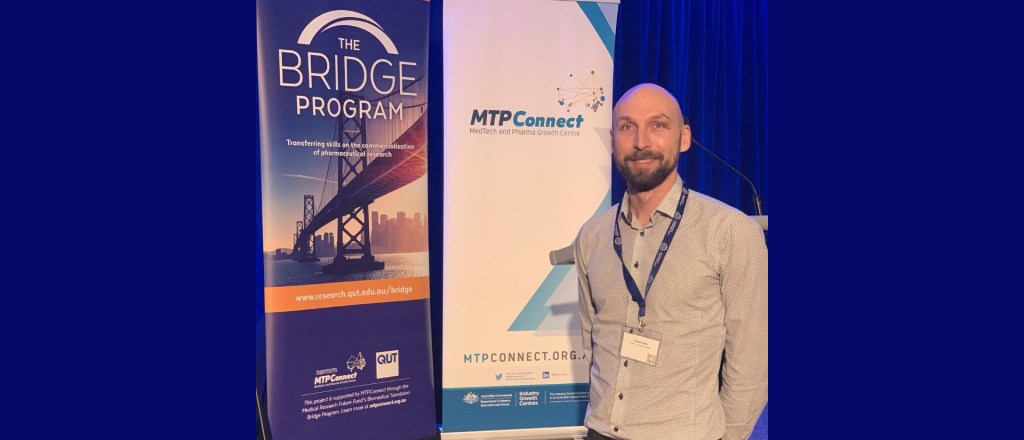
The Bridge and BridgeTech Industry Fellowship Placement

The Bridge and BridgeTech Industry Fellowships, facilitated by QUT and funded by MTPConnect’s Researcher Exchange and Development within Industry (REDI) initiative for the Australian Government’s Medical Research Future Fund, provide up to $10,000 to support the placement of participants and alumni of the Bridge Program and BridgeTech Program within industry. More on the program can be found here.

New Acting Director Compounds Australia

Compounds Australia, through Therapeutic Innovation Australia (TIA), is part of the National Collaborative Research Infrastructure Strategy (NCRIS), a network of world-class research infrastructure facilities that drives and supports greater innovation in the Australian biomedical research sector and associated economic impact. Recently, CFBD CI Prof Sally-Ann Poulsen was appointed as acting Director of Compounds Australia. Curating Australia’s largest collection of compounds and natural products (~1.5M), Compounds Australia supports 38 national/international member organizations and >250 research projects annually, including the fragment screening campaigns of the CFBD. Monash University, University of Sydney and Griffith University are all member organizations. CFBD CI Prof Jonathan Baell is an existing Advisory Board Member of Compounds Australia. Many of the fragment libraries that are used by the Centre are currently managed by Compounds Australia. Congratulations to Sally-Ann on this excellent new role.

Abstract submission extended – FBDD DU 2022

Good news! The abstract submission deadline for the 4th FBDD Down Under Conference will be extended to 29 July 2022.

Important Dates:
Abstract submission deadline oral presentation – 29 July 2022
Abstract submission deadline posters – 12 August 2022
Conference dinner – 28 September 2022
Registration close  – 14 September 2022 (5 pm AEST)

The conference will include workshops, scientific sessions and social events. For more details, please visit the FBDD DU website

Do you want to support this event? We offer a variety of sponsorship packages to help you promote your technology. Contact us to discuss the different options on offer.

New Industry Partner ANSTO

We are delighted to welcome The Australian Nuclear Science and Technology Organisation (ANSTO) as our new Industry Partner to the Centre. ANSTO, Australia’s knowledge centre for nuclear science and engineering, leverages great science to deliver big outcomes. ANSTO partners with scientists and engineers and applies new technologies to provide real-world benefits. Their work improves human health, saves lives, builds our industries, and protects the environment. ANSTO is the home of Australia’s most significant landmark and national infrastructure for research. Thousands of scientists from industry and academia benefit from gaining access to state-of-the-art instruments every year.

Please join us in welcoming Dr Rachel Williamson and Dr Alan Riboldi-Tunnicliffe as our new Partner Investigators. You can also meet them in person at our Joint ANSTO & CSIRO workshop on 12 August 2022. Don’t forget to register your interest with the Centre Manager.

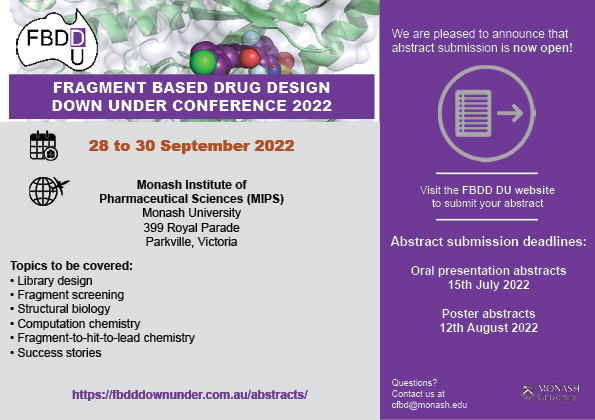
Abstract submission open – FBDD DU 2022

We are pleased to announce that abstract submission for the 4th Fragment-Based Drug Discovery Down Under Conference 2022 is now open!


Important dates

Abstract submission deadline oral presentations:15 July 2022
Abstract submission deadline posters:12 August 2022
Registration open:20 June 2022
Registration close: 14 September 2022

Visit https://fbdddownunder.com.au/ to register your attendance.

We are looking forward to meeting everyone back in Melbourne from 28 to 30 September 2022!

A truly collaborative work – new paper on DsbA

Not one but five CFBD members from our three nodes published a paper on DsbA titled “Identification and characterization of two drug-like fragments that bind to the same cryptic binding pocket of Burkholderia pseudomallei DsbA” in Acta Crystallographica Section D.

Abstract

Disulfide-bond-forming proteins (Dsbs) play a crucial role in the pathogenicity of many Gram-negative bacteria. Disulfide-bond-forming protein A (DsbA) catalyzes the formation of the disulfide bonds necessary for the activity and stability of multiple substrate proteins, including many virulence factors. Hence, DsbA is an attractive target for the development of new drugs to combat bacterial infections. Here, two fragments, bromophenoxy propanamide (1) and 4-methoxy-N-phenylbenzenesulfonamide (2), were identified that bind to DsbA from the pathogenic bacterium Burkholderia pseudomallei, the causative agent of melioidosis. The crystal structures of oxidized B. pseudomallei DsbA (termed BpsDsbA) co-crystallized with 1 or 2 show that both fragments bind to a hydrophobic pocket that is formed by a change in the side-chain orientation of Tyr110. This conformational change opens a `cryptic’ pocket that is not evident in the apoprotein structure. This binding location was supported by 2D-NMR studies, which identified a chemical shift perturbation of the Tyr110 backbone amide resonance of more than 0.05 p.p.m. upon the addition of 2 mM fragment 1 and of more than 0.04 p.p.m. upon the addition of 1 mM fragment 2. Although binding was detected by both X-ray crystallography and NMR, the binding affinity (Kd) for both fragments was low (above 2 mM), suggesting weak interactions with BpsDsbA. This conclusion is also supported by the crystal structure models, which ascribe partial occupancy to the ligands in the cryptic binding pocket. Small fragments such as 1 and 2 are not expected to have a high energetic binding affinity due to their relatively small surface area and the few functional groups that are available for intermolecular interactions. However, their simplicity makes them ideal for functionalization and optimization. The identification of the binding sites of 1 and 2 to BpsDsbA could provide a starting point for the development of more potent novel antimicrobial compounds that target DsbA and bacterial virulence.

Read the full article here.

First Author paper for PhD student Sarah Müller

Congratulations to PhD student Sarah Müller from Griffith University who published a paper as first author. 

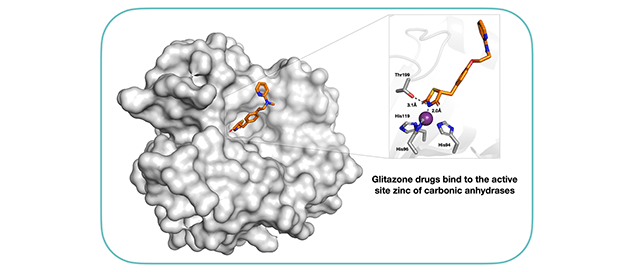
The Glitazone Class of Drugs as Carbonic Anhydrase Inhibitors—A Spin-Off Discovery from Fragment Screening

Most of the drugs we know target the activity of specific proteins that play an important role in the disease being treated. One of the big challenges in the discovery of new drugs is finding molecules that bind specifically to one target and not bind to other proteins too. This is necessary to avoid causing treatment side effects. Hence, drug discovery researchers are always on the lookout for ways to find better lead molecules.
We identified an old drug class called glitazones that target a new protein known as carbonic anhydrase II, an enzyme that helps to maintain pH levels in cells. Carbonic anhydrase comes in many different forms and has been a successful target for drug development for various diseases like glaucoma, heart failure and epilepsy.
The glitazone drugs, such as rosiglitazone, are used to treat Type II diabetes. However, because of the severe side effects caused by the use of glitazones they were taken off the market. Our findings suggest that the unintended targeting of carbonic anhydrase may be one reason for the side effects of these drugs. This shows how important it is to carry out research to fully understand the effect of drugs and can help future researchers in drug discovery.

The paper was published in Molecules in May 2021.

We are hiring – Biomolecular NMR spectroscopist/Structural Biologist

We have a postdoctoral position available for a Biomolecular NMR spectroscopist/Structural Biologist within the ARC Centre for Fragment-Based Design.

The exciting opportunity for a Research Fellow who will be working our Centre. The successful candidate will contribute to research on fragment-based drug design projects with a focus on a range of therapeutic targets across different areas such as infectious disease, cancer and diabetes.

You will have:

  • A PhD in structural biology with related research experience
  • Strong theoretical knowledge of NMR spectroscopy and its application in the analysis of biomolecules
  • Strong practical experimental skills in the characterisation of protein structures from experimental data
  • Prior knowledge and experience in data analytics is desirable
  • Experience with industry will be highly regarded

If you are ready to take the next step in your research career, we look forward to receiving your application.

New paper out by PhD student Karoline Sanches

Congratulations to PhD student Karoline Sanches from Monash University who published a paper as first author. The paper was published in Toxicon in October 2021.

Conformational dynamics in peptide toxins: Implications for receptor interactions and molecular design

Karoline Sanchesa,b,1, Dorothy C.C. Waia,1, Raymond S. Nortona,b
aMedicinal Chemistry, Monash Institute of Pharmaceutical Sciences, Monash University, Parkville, Victoria, 3052, Australia
bARC Centre for Fragment-Based Design, Monash University, Parkville, Victoria, 3052, Australia
1These authors contributed equally

Peptide toxins are often potent and selective blockers of ion channels and are therefore of significant interest to the pharmaceutical and biotech industries. For example, an analogue of the sea anemone peptide ShK, which targets the voltage-gated potassium channel Kv1.3, is currently in clinical trials for the treatment of autoimmune disorders. Studying the structure-function relationship and the dynamics of these peptides is pivotal to understanding their binding to receptors, as well as to designing new drugs. In this article, we highlight the important contribution of NMR to characterising peptide toxin dynamics. It is shown that even disulphide-rich peptides display dynamics in various timescales, the characterisation of which through NMR is crucial for understanding their receptor interactions.