We have a postdoctoral position available for a Biomolecular NMR spectroscopist/Structural Biologist within the ARC Centre for Fragment-Based Design.
The exciting opportunity for a Research Fellow who will be working our Centre. The successful candidate will contribute to research on fragment-based drug design projects with a focus on a range of therapeutic targets across different areas such as infectious disease, cancer and diabetes.
You will have:
A PhD in structural biology with related research experience
Strong theoretical knowledge of NMR spectroscopy and its application in the analysis of biomolecules
Strong practical experimental skills in the characterisation of protein structures from experimental data
Prior knowledge and experience in data analytics is desirable
Experience with industry will be highly regarded
If you are ready to take the next step in your research career, we look forward to receiving your application.
Congratulations to PhD student Karoline Sanches from Monash University who published a paper as first author. The paper was published in Toxicon in October 2021.
Conformational dynamics in peptide toxins: Implications for receptor interactions and molecular design
Karoline Sanchesa,b,1, Dorothy C.C. Waia,1, Raymond S. Nortona,b aMedicinal Chemistry, Monash Institute of Pharmaceutical Sciences, Monash University, Parkville, Victoria, 3052, Australia bARC Centre for Fragment-Based Design, Monash University, Parkville, Victoria, 3052, Australia 1These authors contributed equally
Peptide toxins are often potent and selective blockers of ion channels and are therefore of significant interest to the pharmaceutical and biotech industries. For example, an analogue of the sea anemone peptide ShK, which targets the voltage-gated potassium channel Kv1.3, is currently in clinical trials for the treatment of autoimmune disorders. Studying the structure-function relationship and the dynamics of these peptides is pivotal to understanding their binding to receptors, as well as to designing new drugs. In this article, we highlight the important contribution of NMR to characterising peptide toxin dynamics. It is shown that even disulphide-rich peptides display dynamics in various timescales, the characterisation of which through NMR is crucial for understanding their receptor interactions.
CFBD CI Professor Ray Norton has been awarded a grant worth $49,000 from the Monash Health Foundation 65 km Walk for Cystic Fibrosis Research Funding for his project entitled “Validating a potential new target for the treatment of cystic fibrosis”.
Ray’s project seeks to determine whether the protein channel KV1.3 plays a role in airway inflammation in individuals with cystic fibrosis [CF]. Ray and his team will examine broncho-alveolar lavage [BAL] fluid obtained from both young children with CF and adults with CF following lung transplantation.
Previous research has shown that KV1.3 is involved in other inflammatory diseases such as rheumatoid arthritis and inflammatory bowel disease, but it is unknown if it is also important in CF lung disease or rejection in CF lung transplant recipients.
Lung inflammatory cells from BAL fluid will be tested for the presence of the KV1.3 channel. The group will also analyse BAL fluid from adults with CF post lung transplant, who will be having BAL as part of their routine post-transplant care at the Alfred Hospital Lung Transplant Service. We expect to find that KV1.3 is abundantly present in airway inflammatory cells in both patient groups.
If KV1.3 is detected, the next step will be to test whether blocking this channel with HsTX1[R14A], a novel peptide developed at Monash University, reduces inflammation and lung damage in animal models of CF lung disease and chronic rejection.
Congratulations to CFBD Deputy Director A/Prof Ben Capuano for being appointed as Acting Theme Leader in the Medicinal Chemistry Department at the Monash Insitute of Pharmaceutical Sciences (MIPS).
Ben has taken over the position from Prof Peter Scammells who will now be focusing on his role as Associate Dean, Research, Faculty of Pharmacy & Pharmaceutical Sciences. Within CFBD, Ben leads the Fragment Elaboration theme. He is a synthetic medicinal chemist specialising in GPCRs.
Congratulations to CFBD CI Professor Jonathan Baell for being awarded the Faculty Research Award from the Monash Institute of Pharmaceutical Sciences.
Jonathan discovers new medicines for treating diseases with unmet medical needs with a particular focus on cancer and infectious diseases. His track record is hallmarked by high-quality research outcomes in a variety of different areas, as exemplified by a broad and diverse suite of personally driven but widely collaborative patents integrated with subsequent high-quality publications.
With more than 70 granted patents, throughout his career Jonathan has been a driving force in facilitating commercial outcomes from academic research. At any given time, he incubates a variety of enterprising projects to maximise the chances of multiple translational outputs.
He is also the Director of the Australian Translational Medicinal Chemistry Facility (ATMCF), located at MIPS and which works with researchers nationwide in order to translate biomedical research outcomes. The Facility has secured over $7M in funding to enable the de-risking of projects through medicinal chemistry optimisation. In addition to the enterprise embodied in the ATMCF, Jonathan’s own patented KAT6A anticancer drug candidates have catalysed a global focus by Pharma on KATs as druggable targets. This innovative KAT6A work also has underpinned several awards, including Australia’s highest medicinal chemistry award, the Adrien Albert Award for Sustained Excellence in Medicinal Chemistry (2018), the Monash University Research Award for the Faculty of Pharmacy and Pharmacology (2019), the Scientific Achievement Award in Drug Discovery and Development (2020), awarded by the American Society for Pharmacology and Experimental Therapeutics, and in 2021 The Australian Academy of Technology and Engineering (ATSE) Clunies Ross Award for Knowledge Commercialisation.
The Centre for Fragment-Based Design officially commenced on 22 July 2019 with the execution of our Participants Agreement and the Centre was launched by The Honourable Kevin Andrews MP on 12 November 2019. The launch was held in conjunction with Australia’s national conference on Fragment-Based Drug Design, which allowed us to leverage a full week of activities including our first Scientific Advisory Board meeting and the Centre’s first training events, in partnership with key industry and international stakeholders.
The launch, conference and training workshops were very well received by attendees, with many of our academic and industry participants and other stakeholders in attendance. These initial activities have established a strong base of interest in the Centre for further collaborative opportunities that will drive our research initiatives and support growth, productivity and competitiveness in fragment-based design for the sector.
There was some great coverage of the event. Monash and Griffith both had media releases publicising the launch event, which were picked up by a Universities to Business article.
Our partners GE Healthcare (now Cytiva) had a number of representatives, including Paul Belcher all the way from Boston, who wrote a great LinkedIn article about the event.
Dan Erlanson wrote a great summary article on his Practical Fragments blog.
Our objective to establish a coherent and collaborative national network to provide access to the technology necessary to support fragment screening against a wide range of protein targets, has now been firmly grounded in the established Centre. We now have a strong platform and clear means to implement our training program activities, accelerate research translation and continue to engage with industry to meet the growing needs within the rapidly moving sector.
Professor Martin Scanlon explaining the aims of the ARC CFBD to The Honourable Kevin Andrews MP, the Monash Provost (Professor Marc Parlange), MIPS Director (Professor Chris Porter), Monash DVCR (Professor Rebekah Brown) and ARC CEO (Professor Sue Thomas).
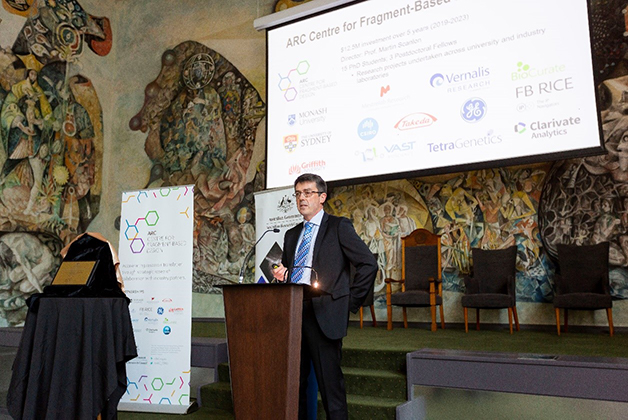
Centre Director, Professor Martin Scanlon speaking about the Centre’s research program and industry partnerships following the unveiling of the plaque.
Feature image: Centre CIs (L-R: Professor Jonathan Baell, Professor Sally-Ann Poulsen, Professor Michael Kassiou, Professor Joel Mackay, Dr Maria Halili, Professor Martin Scanlon and Professor Ray Norton) with ARC CEO Professor Sue Thomas and Centre Manager Dr Narelle Tunstall.





 ARC Centre for Fragment-Based Design