Post written by Yildiz Tasdan, PhD Candidate at the CFBD Monash node
About four years ago, I was interviewed for the ITTC PhD Program on the day I submitted my Master’s thesis in Singapore. Now, I am in England doing my industry placement at Vernalis as part of my PhD at MIPS in Australia, and I have just returned from the US for a conference. I would not think a career in science would give me so many travelling opportunities. All these became possible thanks to the support from ARC CFBD.
My placement started at Vernalis, England four months ago, and I am absolutely loving the industry life. The first thing that surprised me here was how enthusiastic everyone is about research and training. I have been working on the synthesis of an extensive library of compounds using flow chemistry which provides excellent efficiency in the synthesis. I came here with no prior knowledge of flow chemistry. Thanks to the excellent training that my mentors provided, I am getting confident with my knowledge in the field and am willing to learn more. I am also learning about drug design and biophysics from the experts here. Everything I am learning here is in addition to the fundamental knowledge I gained in the first three years of my PhD at MIPS. The ITTC program prepared me for this placement very well, and ultimately it has been preparing me for an industry career.
CHI Drug Discovery Chemistry Conference Poster Presentation Award Ceremony (left to right; Anjani Shah, Yildiz Tasdan, An-Dinh Nguyen)
I was also fortunate to receive the CFBD travel grant to attend the CHI Drug Discovery Chemistry conference in San Diego. I had an opportunity to communicate my research with industry experts from various disciplines and expand my network. I attended two short courses and over 30 talks in 4 days, which was overall very fruitful. Through my poster presentation, I received the best poster prize as well.
I recommend every student and ECR follow the opportunities ARC CFBD offers and reach Anne to propose any training ideas and ask for additional support.
Thank you to Yildiz for writing this guest blog for CFBD and for sharing her experience with us!
Congratulations to our Partner Investigator Professor Susie Nilsson from CSIRO for receiving the 2023 Inspiring Leadership Award from the BioMelbourne Network
Launched in 2015, BioMelbourne Network’s Women in Leadership Awards recognise and champion women who are making outstanding contributions to the health-tech industry. The 2023 Awards Ceremony honoured three remarkable leaders, at different stages of their careers, who have taken strategic risks, tenaciously pursued goals and served as role models to the younger generation.
Susie Nilsson received the award in the category “Inspiring Leadership Award – Making it Happen”. This award recognises women playing an inspiring and pivotal role in the leadership of a project, partnership or collaborative initiative, approximately within the last 5-10 years.
CFBD CI Prof Michael Kassiou, founder of Kinoxis, has secured a lucrative partnership with Boehringer Ingelheim to investigate drugs that treat aggression and social withdrawal in people with psychiatric disorders.
Michael developed small molecules that interact with oxytocin receptors which could be used to target oxytocin receptors with the aim of creating medicine to treat schizophrenia, depression and other neuropsychiatric illness. Read the full article in the Sydney Morning Herald from 4 May.
The challenge in fragment-based drug discovery (FBDD) is not finding hits, we typically find plenty, it’s what to do with them. In their recent publication, Centre members demonstrate a systematic approach for the Rapid Elaboration of Fragments into Leads (REFiL), where they take weak binding fragment hits and quickly develop them into higher affinity ligands that can be used as chemical probes or as starting points for a drug discovery program.
The development of low-affinity fragment hits into higher-affinity leads is a major hurdle in fragment-based drug design. Here, we demonstrate the Rapid Elaboration of Fragments into Leads (REFiL) by applying an integrated workflow that provides a systematic approach to generate higher-affinity binders without the need for structural information. The workflow involves the selection of commercial analogues of fragment hits to generate preliminary structure–activity relationships. This is followed by parallel microscale chemistry using chemoinformatically designed reagent libraries to rapidly explore chemical diversity. After a fragment screen against bromodomain-3 extra-terminal (BRD3-ET) domain, we applied the REFiL workflow, which allowed us to develop a series of ligands that bind to BRD3-ET. With REFiL, we were able to rapidly improve binding affinity > 30-fold. REFiL can be applied readily to a broad range of proteins without the need for a structure, allowing the efficient evolution of low-affinity fragments into higher-affinity leads and chemical probes.
Dr Louise Sternicki was one of the recipients of the inaugural CFBD Travel Grant in 2022. In the following, she writes about her research visit to Arizona and to Florida.
2023 got off to an exciting start for me thanks to the CFBD travel grant that I received last year. At the end of the first week in January, I left for an almost 3-week trip to the US. I first headed to the deserts of Tucson, Arizona where I spent a week and a half in the lab of world-leading native mass spectrometry expert Associate Professor Michael Marty at The University of Arizona. Michael had visited GRIDD a few months prior, in November 2022, and this placement provided the opportunity to further build collaboration and follow up on some of the ideas discussed.
Whilst in the Marty Lab, I got hands-on experience with cutting-edge MS instrumentation and the emerging technology of charge detection native mass spectrometry. This technique is only available in a handful of labs worldwide and this placement gave me an opportunity to develop skills not currently in Australia and the ability to analyse my biomolecule samples with a technique that wasn’t possible back home. With this instrumentation and technique, I obtained novel data for new and existing collaborations that revealed new biological insights. The placement also allowed me to learn sample prep and native mass spectrometry methodologies for the analysis of membrane proteins – knowledge that will allow me to further the progress of my own research projects.
The Marty Lab was very welcoming both within and outside the lab. It is always insightful to visit another lab and see how things are done differently. I learnt so much in one week from many members of the group across everything mass spectrometry. I also got to eat lots of amazing Mexican, go hiking in the Arizonan desert amongst giant cacti, see snow on the mountains and visit the cold war missile museum to see a real (and thankfully deactivated!) nuclear missile in its silo.
After my research placement, I then travelled to St Pete Beach, Florida to attend the American Society for Mass Spectrometry Sanibel Conference on Membrane Proteins and their complexes. This conference had been delayed twice due to COVID, so everyone was very excited for the conference to finally go ahead in person – perhaps also because it was hosted at a beachside resort! Attending this conference was an amazing experience, learning about all the fantastic MS-based research occurring internationally, including getting to hear from Professor Dame Carol Robinson in person, and meeting leading MS researchers over the meal breaks. I was also fortunate enough to get the opportunity to chair one of the sessions during the conference. I came away from the meeting with many new ideas and further experience and knowledge for how to go about carrying these out, or the people to follow up with to achieve this. This was the first ASMS conference I had attended in person and the sense of community was incredibly welcoming. I will be looking out for further opportunities to attend their conferences in the coming years.
This opportunity would not have been possible without the award of the CFBD travel grant. Originally, I only intended on attending the conference, however, I was also awarded a Griffith Institute for Drug Discovery Director’s Circle Professional Development Award that provided me with further financial support that enabled me to include the research placement. Both experiences were incredibly valuable for my professional development and also created some great memories.
CFBD researchers are again invited to apply for a CFBD Travel Grant to the value of up to $3,500. This grant may be used for travel to a national or international conference, a visit to a partner organisation for research collaboration or a visit to a research laboratory to learn a new technique. The CFBD TravelGrant is an annual award.
CFBD members Karol Sanches, Yildiz Tasdan and Jack Phelps (all Monash) have started their international placements as part of their ARC scholarships. While Karol has already completed her placement with TetraGenetics in Boston (USA), Yildiz and Jack are working at Vernalis in the UK. Here, Jack talks about his experience during his first couple of weeks:
“How time flies! It still feels like yesterday that I was saying goodbye to Melbourne and flying home to the UK to start my placement at Vernalis, Cambridge. I’ve now somehow been here for 3 months and am loving the experience of working in the industry. Of course, there are similarities (every day starts with coffee before setting up experiments), but also many notable differences. As expected (but slightly annoyingly) there’s a real sense that money, not discoveries themselves, is the driving force behind each project here, and when talking about my work it’s difficult to describe the end goal in terms of industry buyouts (which feels a long way off yet!). On a more personal note, the most exciting difference for me is on the technology side: All the columns are automatic and can be monitored remotely from your desk! Luckily, this is the case in protein purification too, as I’ve become much more of a biologist over the past couple of months. This brings me to the other major new experience in industry – not having to make up LB or wash/autoclave your own glassware! Call it laziness if you’d like, but I prefer to think of it as more time to spend doing the science… As well as protein science, I’ve also been fortunate enough to model protein sequences using AlphaFold and to start exploring crystallography. All this being said though, I’m still missing the people at MIPS that kept me going during my PhD. With all the new helpful technicians and processes, there’s no substitute for the community of students and the city of Melbourne.”, Jack Phelps (Monash)
We will post more updates from Karol and Yildiz soon. Stay tuned!
We are delighted to announce that Dr Stefan Nebl from the Scanlon group at Monash University has been conferred the award Doctor Of Philosophy on 8 December 2022. Congratulations, Stefan!
Stefan’s thesis is titled: NMR-Based Structural And Dynamic Characterization Of Bacterial Dsb Enzymes To Support Fragment-Based Drug Design, makes a distinct and significant contribution to knowledge.
We are very thrilled and can’t wait to hear about his future endeavours.
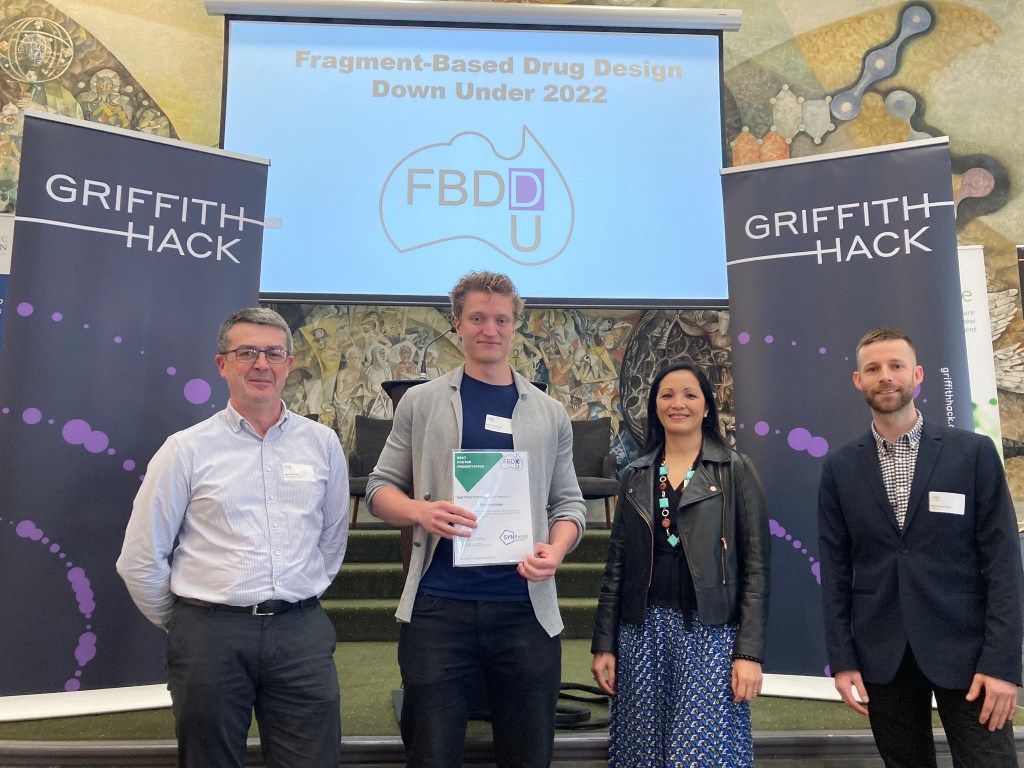
The 2022 FBDD DU Conference proved to be a huge success for CFBD members. We heard fantastic presentations from the plenary speakers and fascinating stories from the presenters with a good number of Centre members represented. We saw brilliant posters and made new connections during the networking sessions. Adding to this, our members hit the jackpot with the FBDD DU presentation prizes. Congratulations to:
Louise Sternicki (Griffith) for winning the Best ECR Oral Presentation Award
Jeyan Osman (Monash) for winning the Best Student Presentation Award
Yildiz Tasdan (Monash) for winning the Student Presentation – Runner-Up Award
Max Lumetzberger (Monash) for winning the Best Poster Presentation Award
Evgenia Konstantinidou (Monash) for winning the Poster Presentation – Runner-Up Award






 ARC Centre for Fragment-Based Design